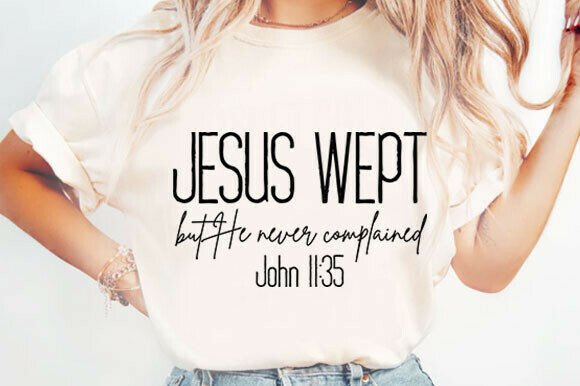
Jesus Wept Christian SVG
A Quiet Design That Carries Weight—Not Just Words
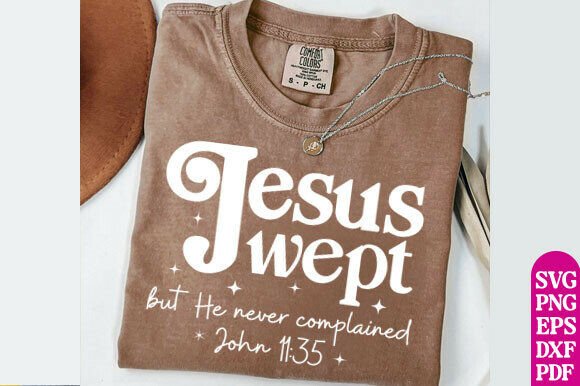
When I opened Jesus Wept Christian SVG for the first time, I didn’t see a cliché. I saw restraint. The phrase “Jesus wept” is sparse—just two words—but the design carries gravity through simplicity: clean serif lettering, modest spacing, and a subtle curve to the baseline that feels human, not mechanical. It’s not ornate, not floral, not framed in doves or crosses. That’s its strength—and its warning. This isn’t a design that shouts. It’s one that settles. Which means it works beautifully on a soft cotton baby blanket for a newborn dedication service—but would feel emotionally mismatched on a neon gym tank top.
Where It Shines: Real Projects, Real Reactions
Last week, I stitched Jesus Wept Christian SVG onto a heavyweight organic cotton tote bag for a local church boutique. No appliqué, no fill-heavy embellishment—just a single-layer satin stitch outline with gentle tapering on the terminals. The result? Crisp, legible, and deeply personal. Customers paused. Some smiled quietly. One woman bought two—one for herself, one “to give to my sister after her diagnosis.” That kind of resonance doesn’t come from complexity; it comes from clarity and emotional alignment. I’ve also used it as a small chest embroidery on a cream linen apron for a faith-based cooking class—tiny (3.2" wide), stabilized with tear-away + light cutaway, and it held beautifully through repeated washes.
It performs well across several categories within T-Shirt Designs, especially where tone matters more than trend: sweatshirt embroidery for pastoral staff, pillow covers for hospice ministry gifts, tea towels for church bazaars, and even minimalist patches for youth group jackets. Its low visual noise makes it ideal for layered garments—think lightweight cardigans or unstructured blazers—where busy designs get lost. And because it avoids dense fill stitches, it breathes on knit fabrics without puckering, provided you use appropriate stabilizer.
Where It Needs Careful Handling
- Small hoop sizes: Below 3", letterforms start to lose definition—especially the fine serifs. If you’re stitching on a child’s cap or baby onesie, test the smallest viable size first. You may need to simplify or remove decorative terminals.
- Textured or stretchy fabric: On terry cloth towels or ribbed knits, the clean lines can blur if stabilizer isn’t matched precisely. A medium-weight cutaway works better than tear-away here.
- Dark or heavily dyed fabric: The design relies on contrast. On navy or charcoal, light thread (ecru, soft gray) reads better than stark white—it keeps the mood reverent, not clinical.
- Curved surfaces: Caps and curved pillow edges distort fine horizontal spacing. Slightly increase letter tracking in your embroidery software before digitizing—or choose a flatter application area like the left chest.
- Frequent-wash items: While satin stitch holds up well, avoid placing it directly over high-friction zones (e.g., center back of toddler tees). A side-seam placement on a onesie lasts longer.
What It Adds—And What It Doesn’t Pretend To Be
Jesus Wept Christian SVG elevates handmade product value by signaling intention—not just decoration. When customers see this on a nursery pillow or a grief support journal cover, they register care, not craftiness. It builds trust because it doesn’t over-promise. There’s no glitter, no halo effect, no forced cheer. That authenticity translates directly to buyer engagement: Etsy sellers report higher conversion on listings where the design appears in quiet, real-life contexts—a folded towel on a wooden shelf, not a flashy mockup with animated shadows.
But let’s be clear: it’s not a versatile all-rounder. It won’t anchor a bold holiday embroidery collection. It won’t scale dramatically for a large tote front without losing its delicate balance. And it doesn’t lend itself to playful color blocking or trendy gradients. Its power lies in its limits—and knowing those limits is what separates thoughtful embroidery from filler work.
Practical Designer Notes Before You Stitch
- Always test on scrap fabric—especially if using textured weaves or blends. Watch how the serifs hold up after trimming and washing.
- Check thread color contrast in natural light. What looks balanced on screen often flattens on fabric.
- Review stitch density. Low-density satin stitch is fine here—no need to over-pack. Too many passes = stiff texture and thread breakage.
- Confirm hoop size compatibility before committing to a garment layout. Some versions of this design may extend beyond standard 4x4 hoops.
- Inspect small details at actual stitch-out size—not just zoomed-in on your computer. Tiny curves and terminal points must translate cleanly.
- Test black-and-white mockups to assess readability on both light and dark backgrounds. This design lives or dies by legibility.
- Use proper stabilizer: light cutaway for stable wovens, medium cutaway for knits, and always float a layer for nap-heavy fabrics like fleece.
- Verify licensing before selling finished items or listing the digital embroidery file. Not all Christian-themed designs permit commercial embroidery resale—check terms carefully.
Final Thought: A Design That Earns Its Place
As an embroidery designer who’s reviewed hundreds of faith-based files, I don’t reach for Jesus Wept Christian SVG when I need volume, versatility, or viral appeal. I reach for it when I need meaning that lands softly but stays. It fits best in quiet corners of the craft business—personalized gifts with soul, boutique merchandise with depth, and custom apparel that serves something larger than aesthetics. Whether you’re an Etsy seller building a curated collection, a small shop owner sourcing meaningful inventory, or a maker stitching for someone walking through sorrow, this design doesn’t distract. It accompanies. And sometimes, that’s exactly what a finished product needs to do.